
Abhyanga: A radical act of self-care in our ridiculously fast-paced world

I’m not sure we were meant to live this fast.
Our attention is pulled in a hundred directions. Our schedules are full. Our minds are teeming. There is always another message to answer, another thing to read, another thing to worry about, another thing we should probably be doing.
And somehow, this has all started to feel normal.
Sometimes I wonder if we’ve gotten so used to the pace that we don’t even notice what it’s doing to us.
Ayurveda has a language for these qualities: Vata.
Vata is movement. Air and space. Quickness, change, stimulation, ideas, creativity. We need those qualities—they’re part of what makes life interesting and alive.
But we definitely need the opposite, too.
Stillness. Warmth. Nourishment. Time to actually inhabit the lives we’re moving through.
And as we move into fall—a season that brings even more of Vata’s cool, dry, changeable qualities—I find myself reaching more intentionally for practices that offer exactly that balance.
Which brings me to one of my very favorite Ayurvedic practices: abhyanga.
Abhyanga (pronounced uhb-HYUNG-guh) is the practice of massaging warm oil into the body before bathing.
I’ll admit, I wasn’t immediately sold when I first learned about it. Oil all over my body? And then I’m not supposed to scrub it all off with soap?
But fast forward a few years and I can’t imagine my life without this practice. My skin is healthier than it has ever been, and I’m addicted to how it makes me feel: Calmer. More grounded. More at home in my body.
For those few minutes, I’m not answering anything. I’m not scrolling or working or thinking about what I need to do next. I’m just there, taking care of myself.
Want to try it? Here’s how:
Traditionally, sesame oil is a great choice for Vata season because it’s warming and grounding. Look for plain, organic sesame oil like this— not the toasted stuff you use for stir-fry. :) Different oils can be used depending on your constitution and what’s going on in your body, but we’re keeping this simple. If you’re not sure which oil would be best for you, feel free to reach out and ask me. I’m happy to help.
First, warm a small amount of oil. Don’t skip this part! Warm oil feels completely different on the body than cold or room-temp oil, and the warmth is part of what makes the practice so beneficial.
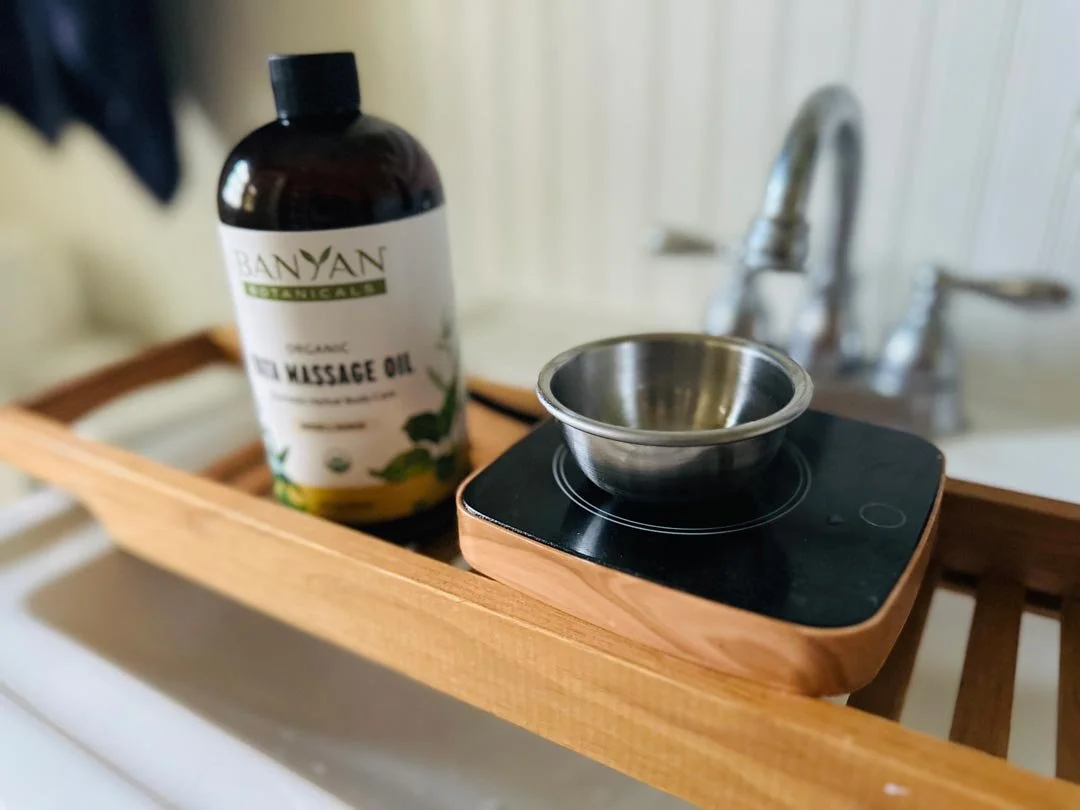
My little abhyanga setup: an electric mug warmer + small stainless steel vessel. You can also just heat the oil by placing the bottle in a sink of hot water.
Then massage a thin layer over your face, ears and body, using long downward strokes on your arms and legs and circles around your joints, chest and belly. (You do not need to be dripping in oil. A little goes a long way.)
Let it soak in for 5–10 minutes. My bathroom is small, so I usually put on a robe, sit on the side of the tub, close my eyes, and spend a few minutes paying attention to my breath.
Then take a warm shower. Not scalding hot so your skin turns red—just warm and soothing. You really only need soap on the “important” bits (as I like to say: pits, privates and piggies). Let the warm water rinse the rest.
And this is the part that surprised me when I first started: you don’t come out greasy. Your skin just feels GOOD. And your mind does, too. You’ve just given yourself an enormous gift: a little time, presence and care.
The Sanskrit word for oil is sneha. And I think this is so cool: sneha also means love.
Isn’t that perfect?
Abhyanga is exactly this: a small, intentional act of self-love.
We are worthy of that. And in a world that moves this fast, I think we need it.
For a more detailed guide that you can download and tape to your bathroom mirror, here’s a PDF I put together:
P.S. A quick note before you get oily: Abhyanga isn’t recommended when you’re sick or congested, during the heavier-flow days of menstruation, or when there are significant signs of ama (undigested metabolic waste) or blockage in the body. If you’re not sure whether any of that applies to you, reach out and ask me. I’m happy to help!